
Mayor Joe Preston: Strong governance, not strong mayors, key to city success
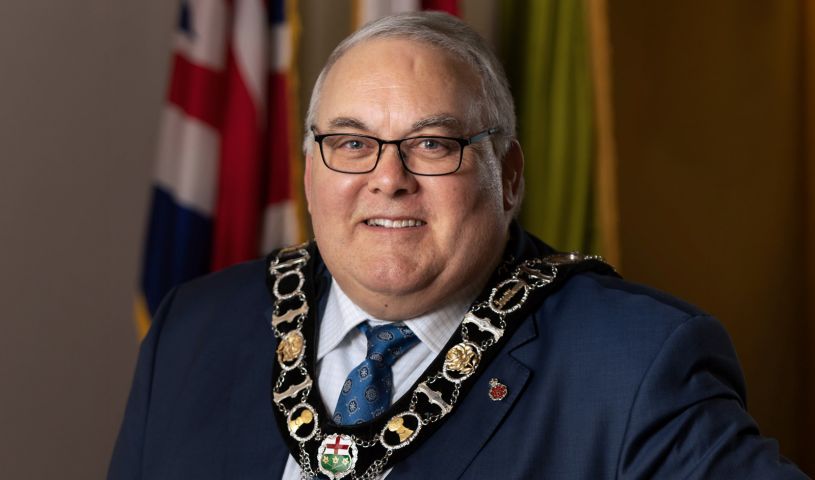 St. Thomas Mayor Joe Preston says he’s stepping away after years of public service, adding that the city’s real success has come from working together and staying focused on good governance – not from any “strong‑mayor” powers. Photo: City of St. Thomas
St. Thomas Mayor Joe Preston says his decision not to seek re‑election in 2026 only came after what he describes as “real soul searching” about his future and that of the city he has been serving for some 20 years.
“We had to make that decision: is this year best or is four years from now best?” he said. “And with some of the things we’d still like to do in life, we kind of had to come to this conclusion.”
Preston has long been a fixture in the southwestern Ontario city. Before becoming St. Thomas mayor in 2018, Preston served as Elgin-Middlesex-London MP from 2004 to 2015.

Preston said Ontario’s strong mayor system – which requires a by‑election if a mayor resigns mid‑term – forced him to think in fixed four‑year blocks. Since he believes in completing what he starts, Preston said that left him with two options: commit to another full term or carry the role into his mid-70s.
“I turn 71 this year and that would make me 75 at the end of that term. So, I said to myself, ‘Look, we’ve got a lot done in this 20-year adventure, in the eight years as mayor’,” Preston said. “‘I think my life can be different, but I’m not certain there’ll be too much more different we can make for St. Thomas. So let’s make the decision now’.”
A Push From Home
Preston credits his wife, Stephanie, with helping him see the decision more clearly.
“She said, ‘Your biggest worry is about who’s going to run next,’ and I went, ‘Yes, I have a great concern that we carry on with some of the great things we’ve been working on’,” he said. “And she said, ‘Well, aren’t you arrogant thinking you get to control that?’”
Preston said the comment landed exactly as intended. He joked that he appreciated his wife’s bluntness – even if it stung a little – as she reminded him that while he might hope to shape the future, the final choice belongs to voters, not to him.
That reminder, he said, brought him back to the fundamentals of public service.

“She reminded me of public service, and I said, ‘You know what, you’re absolutely right’,” Preston said. “This decision is only mine, not what I think I can control about the decision.”
Legacy of Housing, Economic Growth
Since announcing his intentions in February, Preston has been asked to reflect on the things in his career he holds most fondly.
Preston said the city’s work on homelessness stands out the most.
“I think that what St. Thomas has been able to do from a homeless point of view in the last number of years is probably the most significant thing happening in almost any municipality across the country,” he said. “We’re going to get to the end of our by‑names list in the next 12 to 18 months based on the work and construction we’re doing.”
He said the city’s approach – prioritizing housing creation and working closely with partners like Indwell – has produced measurable results.
“I’m proud that over the last two or three or four years, we haven’t had anybody living on the streets,” he said. “You can’t find an encampment in St. Thomas, because council agreed that housing is the purview of municipalities.”
At the same time, he said, the city has achieved major economic development wins. Most notably, PowerCo has moved ahead with the largest investment – construction of the company’s first North American electric vehicle battery cell gigafactory. The project is expected to create up to 3,000 direct jobs and thousands more indirect jobs when operational in 2027.
“We attracted more foreign investment than any other community in Canada,” he said. “To be proud at both ends of an economic spectrum – from homelessness to major industry – is quite unique.”
Successful Governance Philosophy
Preston said the next mayor will need a clear understanding of the difference between governance and management – a distinction he believes many municipalities struggle with.
“If I could find something that is honestly like the on‑off switch for effective councillors and effective mayors, it is a belief that you’re a governance instrument, not a management instrument,” he said. “Too many councils spend too much time acting as if they’re the managers.”
He said St. Thomas council made a deliberate shift eight years ago. For example, it might be up to council to decide whether the city needs a new pipeline, but they don’t decide what size it is or what colour the pipe is. That, he added, is why the municipality hires experts.
That shift, he said, has made council more efficient and more focused.
“Our average council meeting is under an hour,” Preston said. “I can’t find municipalities around me that accomplish the amount we accomplish in a shorter period of time.”
Why Co-operation Matters
Preston said his optimism about the future of municipal government depends entirely on whether councils and other orders of government can work together.
“If you follow the correct model, I’m exceptionally excited,” he said. “But it means working well with other levels of government, and you cannot always count that that is going to be really easy to do.”
He pointed to the city’s recent economic development successes as proof of what can happen when governments align.
“A couple of the very big economic things we’ve accomplished here were accomplished because the federal government, the provincial government, and the municipal government, and including county government sometimes, all work together and rowed the boat in the same direction,” Preston said. “If you get that, you can really envision a bright future.”
This also helps explain, Preston said, why St. Thomas has made progress on homelessness while larger neighbours like London continue to struggle. Preston said the answer lies in governance discipline.
“Once a decision is made, it’s unanimous – we’re all going to drive it forward. It’s what we decided to do, whether you won or lost on the vote,” Preston said, adding that other councils get bogged down in the wrong details. “I’m not certain if I went to London and polled councillors that they’d all agree on the number one job of the city.”
Next Generation of Municipal Leaders
Preston said he has already spoken with several people considering running for office this year.
He said he has already spoken with about five prospective candidates this year and stressed that anyone who thinks they can do the job by stepping in for their CAO or department heads is mistaken – that approach simply won’t work.
He added that understanding the Municipal Act – and its limits – is essential.
“Know how the system runs and the limitations it puts on councils. The best way to move things forward is through a very co-operative way of working together,” Preston said, adding that leadership at the council table is not limited to the mayor’s chair. “There are very few soapboxes you can stand on and win an individual issue. But there’s a way to gather five people who believe the same thing and move that issue forward.”
With that approach in mind, Preston also weighed in on Ontario’s strong‑mayor powers. But he believes the term itself is misleading.
“It’s a misnomer – it is not the strong mayor’s powers,” Preston said. “It’s weak mayors that need those powers to manage a council that can’t see itself as also having to make decisions.”
Looking Ahead to a Slower Pace – Maybe
Preston says he isn’t entirely sure what comes next, but he knows he won’t be idle.
He said that in just the past month he’s launched two new Wendy’s locations and some people tease him, asking whether he wasn’t already busy enough without taking that on as well. But he added that he has a strong partner who is eager to move forward with the expansion.
He said stepping back into the business world offers both familiarity and a new kind of challenge.
“I’ve opened a lot of these in the past, so I think I’ll have to spend some time really looking at our business model,” he said. “And that may mean we go do some more of what we’re currently doing.”
He also hopes to spend more time with family. Recently, Preston spent Family Day weekend at his cottage, enjoying a quiet, relaxing break. He got to see his grandkids and spent a few days doing “very little” – and he’s hoping to make more time for that.
Still, he said he knows himself well enough to understand he’ll need purpose.
“When I left federal politics, it just about killed me. I tried to retire instead of just slow down,” Preston said. “I’ll be looking for a community effort that I can still do. This council – and anybody who thinks they might run for mayor – should know that I will still be here to haunt them. And certainly watch my favourite city as to how it continues to grow with the base we put in place.” MW
✯ Municipal World Executive and Essentials Plus Members: You might also be interested in Kate Graham’s article: Leading in chains – The tough job of being a mayor in Canada.
Sean Meyer is digital content editor for Municipal World.
Related resource materials: