
UBCM president emphasizes pluralism after poorly received B.C. budget
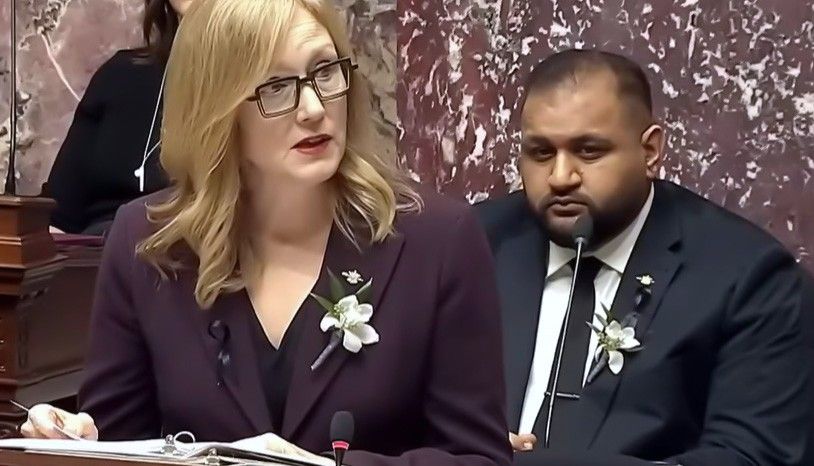 British Columbia Finance Minister Brenda Bailey delivered the province's 2026 budget on Feb. 17. Photo: Government of B.C. YouTube
British Columbia’s 2026 provincial budget is prompting unease among local governments, who say the fiscal plan clouds the future of affordable housing and leaves municipalities bracing for uncertainty.
But amid the concerns, Union of BC Municipalities (UBCM) president Cori Ramsay is urging a pluralistic approach – one she describes as essential to navigating disagreement and maintaining productive relationships with the province.
The budget, introduced Feb. 17 by Finance Minister Brenda Bailey, increases government spending by $3.9 billion while projecting deep deficits of $13.3 billion, $12.2 billion, and $11.4 billion over the next three fiscal years. It also slows the province’s housing strategy, reduces local government transfers, and confirms the indefinite closure of the Community Housing Fund – a move Ramsay said jeopardizes municipalities’ ability to meet provincially mandated housing targets.
Another key to the budget is the province’s announced plan to reduce the public sector by 15,000 full‑time‑equivalent positions over three years – a 3.4 per cent reduction – including 2,500 civil service roles.
Addressing a Mixed Picture
Ramsay said local governments entered budget day hoping for clarity and stability. What they received instead, she said, was a mixed picture – and a reminder of why pluralism matters.
“In today’s world, we have to just be really pluralistic in how we engage with everyone despite maybe contrary perspectives,” she said. “I really focus on pluralism, and I am not frustrated.”
Ramsay’s emphasis on pluralism – the idea that progress depends on engaging respectfully across differences – shaped her response to the budget. While she acknowledged the province’s fiscal challenges and the disappointment felt by municipalities, she repeatedly returned to the importance of maintaining constructive dialogue.
“I think that we have an opportunity to come together and really do good work for community in partnership,” Ramsay said. “That’s an important element here.”
Housing Strategy Slowed
The most significant concern for municipalities is the province’s decision to slow its housing strategy by reallocating $1.4 billion over three years — including shutting down the Community Housing Fund, a program Ramsay said supported the construction of affordable rental homes.
UBCM – in an article published in The Compass – states the fund is being closed “indefinitely,” with the province set to contact local governments that already have applications in the queue.
Ramsay said the closure was not clearly signalled in the budget documents, but UBCM’s early analysis indicates the program is effectively ending.
“This was a provincial fund that’s really designed to support the construction of affordable housing,” she said. “Below‑market housing is challenging to build in community … this was really a main program that was doing that in B.C.”
The timing, she added, is especially problematic because the province has imposed housing target orders on municipalities.
“This is really going to jeopardize the ability of local governments to achieve those targets,” she said. “We are hoping, if the province is giving itself flexibility in meeting its goals, that that courtesy will be extended to local governments.”
Local Government Transfers Reduced
Municipalities will also see a reduction in provincial transfers. Appropriations for local government services will drop by $10 million in 2026-27, from $218 million to $208 million.
Ramsay said UBCM’s advocacy work is continuous – and grounded in the same pluralistic approach she applies to budget discussions.
“Our advocacy is always ongoing,” she said. “If you are advocating the day after budget, I would say that maybe you’ve missed the mark.”
FireSmart Funding Partially Restored
One area where UBCM saw partial success was wildfire mitigation.
The FireSmart Community Funding and Supports (FCFS) program – which supports communities in reducing wildfire risks – was nearly out of funds, Ramsay said. UBCM had pushed for a $40‑million top‑up to prevent the program from being defunded entirely.
The budget allocates $15 million to the program, enough to support the current intake period.
Ramsay called the funding “good news, bad news,” noting that while the amount falls short of what UBCM requested, it prevents a complete shutdown.
“Spending on prevention is a really important piece and a better use of funds than spending on recovery,” she said. “Our fire chiefs, our councils, our regional districts know firsthand how valuable the program is.”
Public Safety Investments
The budget includes $139 million over three years to address repeat violent offending, chronic property crime, and street disorder. This includes:
- $73 million to improve access to the justice system
- $16 million for the Chronic Property Offending Intervention Initiative
- $26 million for the Repeat Violent Offending Intervention Initiative
- $24 million for targeted enforcement programs
The province is also allocating $131 million for intensive mental‑health and addictions treatment, including new involuntary care facilities in Prince George, Maple Ridge, and Surrey.
Capital Spending and Tax Changes
Budget 2026 commits $37.7 billion in taxpayer‑supported capital spending over three years, including:
- $13.8 billion for transit and transportation
- $11.1 billion for health care facilities
- $3.9 billion for seismic school upgrades
Crown corporations will invest an additional $15.3 billion, largely in electricity generation and transmission.
Tax changes include increases to the Speculation and Vacancy Tax for foreign owners and untaxed worldwide earners, increasing to four per cent (from three per cent) for foreign owners and untaxed worldwide earners starting Jan. 1, 2027. Additional School Tax rates on high‑value properties will also rise, and the Property Tax Deferment Program will shift from simple to compound interest.
Pluralism as a Strategy
While most media commentary around the budget has been largely negative, Ramsay resisted framing the budget as a confrontation between municipalities and the province. Instead, she repeatedly returned to pluralism as both a personal philosophy and a practical tool.
“I’m really good at getting answers,” she said. “But I think that really goes back to that pluralism piece of just maintaining respectful relationships and constantly coming to the table.”
She acknowledged that municipalities will have tough questions – especially about the housing fund – and that UBCM will be responsible for helping them understand the implications.
“We’re here for our members,” she said. “We’re doing advocacy for them, and we’re going to get the answers to the questions that they have.”
But she also stressed that disagreement does not have to derail co-operation.
In a budget year defined by deficits, delays, and difficult trade‑offs, Ramsay’s message is clear: pluralism isn’t just a talking point – it’s the strategy she believes will keep local governments and the province working together, even when the path forward is uncertain.
“We have a great relationship [with the province], and I think they’re open to hearing us,” she said. “It’s just they have a lot of decisions and choices to make that we don’t always agree with.” MW
✯ Municipal World Executive and Essentials Plus Members: You might also be interested in Zachary Spicer, Joseph Kushner, and J. F. Lamarche’s article: Political budget cycles in municipal governments.
Sean Meyer is digital content editor for Municipal World.
Related resource materials:
- UBCM president steps up with eyes on advocacy, equity, and urgency
- Several western municipalities sign Indigenous partnerships
- AMO finds pros and cons in 2025 Ontario budget