
Canada’s big-city mayors see opportunity in Carney meeting
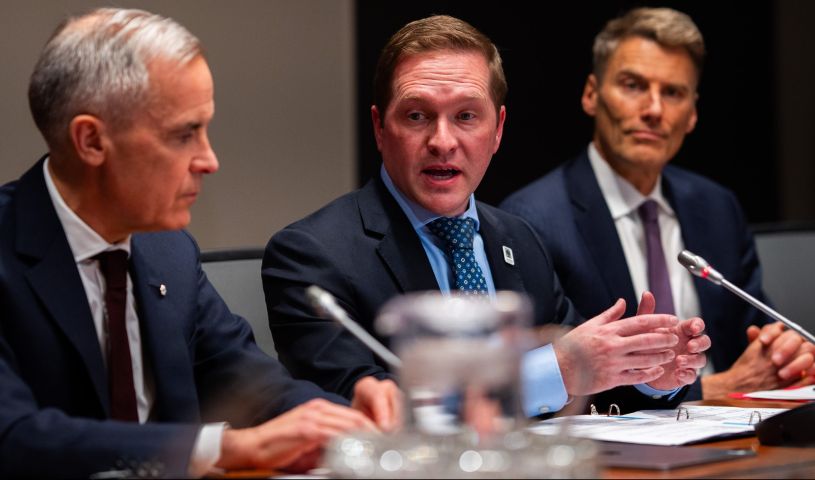 Prime Minister Mark Carney (left) speaks to Big City Mayors’ Caucus chair Josh Morgan (centre), who is also the mayor of London, alongside the federal Housing and Infrastructure Minister Gregor Robertson as part of the caucus' meeting with the federal government, which took place on Feb. 4. Photo: Federation of Canadian Municipalities
Prime Minister Mark Carney’s first formal meeting with the Federation of Canadian Municipalities’ (FCM) Big City Mayors’ Caucus set a collaborative tone for federal-municipal relations, according to London Mayor Josh Morgan.
Morgan, who chairs the caucus, said he entered the meeting (Feb. 4) with “really positive expectations” – and left feeling they had been fully met.
“I knew it was going to be a pretty direct and productive meeting,” Morgan said. “If he’s having a meeting, it’s not just to talk, it’s to try to get some things done.”
Shared Agenda for a Changing Country
Morgan said the mayors and the prime minister quickly found common ground on issues ranging from housing and infrastructure to trade, economic resilience, and national security.
Carney has an “ambitious Canada‑building agenda,” Morgan said, adding that cities will be at the centre of that effort.
He also pointed to Carney’s focus on strengthening trade corridors and doubling east‑west output – goals that rely heavily on urban infrastructure.
“You can’t diversify trade corridors and double outputs east and west without that trade‑related infrastructure going through Canada’s major cities and ports,” Morgan said. “We have a great shared perspective and shared set of goals. We have the potential to do a lot of really great things for the country in partnership together.”
Navigating an Unpredictable Landscape
Carney’s conversation with the mayors also touched on the shifting geopolitical environment, particularly the uncertainty surrounding U.S. policy. Morgan said this makes co-ordination among Canadian governments even more critical.
Morgan pointed to the recent controversy over the Gordie Howe International Bridge as an example of how quickly circumstances can change.
“You can wake up the next morning, and things can have shifted overnight,” he said. “There’s not a lot of predictability coming out of the United States. In that sort of environment, what we can do is be stable, measured, planned, and well‑positioned to react.”
Domestic alignment, he added, is Canada’s best defence: “When we act in unison and when we work together, there’s a lot of strength in that response.”
Infrastructure Is Where Everything Begins
Morgan said the mayors made clear that infrastructure is the foundation of every other national priority – and he believes the federal government understands that.
He emphasized that municipalities own and operate most of the infrastructure needed to support both economic growth and housing expansion. Morgan said the federal government appears aligned with cities on accelerating investment.
Cities, Morgan said, have extensive experience managing the systems that enable growth, including underground water and wastewater infrastructure, road networks, and transit services. He noted that these assets form the backbone of Canada’s national ambitions. Without the urban roads, bridges, and transit routes that move people and goods, he added, the country cannot realistically expand its export capacity.
“If we’re going to put our money where our mouth is, that money is going to go into critical infrastructure in this country,” he said. “We’re certainly aligned on partnering to do that as quickly and efficiently as possible.”
Housing Needs Require Operating Dollars
Housing was another major focus of the meeting, and Morgan said the mayors and the federal government share a keen sense of urgency around both supply and affordability.
He noted that Ottawa’s commitment to capitalizing the new Build Canada Homes entity signals an understanding that Canada must build market‑rate units and supportive housing at the same time.
Morgan emphasized that supportive housing provides broad community benefits by reducing pressure on emergency rooms, police services, and ambulance calls when people have stable housing and the right supports. He cautioned, however, that capital funding alone will not solve the problem. Operating dollars, he said, are essential to ensure new supportive housing units can function effectively.
“We’re very aligned on housing and housing affordability,” he said. “We’ve got to build more homes, but we also need affordability so a wider range of Canadians can access stable housing.”
National Co-ordination for Public Safety
Morgan highlighted public safety as a priority for FCM in its conversations with the prime minister, adding that it intersects with economic development, housing, and quality of life.
Public safety, Morgan said, is critical to the success of all those other components, especially when the goal is to have “safe, secure streets and safe downtowns.”
He noted that criminal organizations – including international networks – are increasingly active in Canadian cities.
“Extortion is a rising concern in multiple cities, both in Ontario and out west,” he said. “International organizations engaged in those activities require a strong and co-ordinated response.”
At the mayors’ meeting, the Canadian Association of Chiefs of Police briefed municipal leaders on emerging threats. Morgan said the message was clear that the public expects “no less” than a unified response.
He also praised the federal government’s proposed bail reform legislation and emphasized the caucus would like to see legislation passed as quickly as possible.
“We all have examples of violent and repeat offenders being released on bail and then committing subsequent crimes,” said Morgan, adding that the caucus supports the proposed reverse‑onus approach for violent and repeat offenders. “It will lead to more violent and repeat offenders being held on bail and not being on the streets.”
Balancing Urgency with Strategy
As the conversation turned to the pace of change, Morgan acknowledged the tension between the need for rapid action and the realities of government decision making.
He said the public expects governments to move quickly on critical issues – but also to get things right.
Governments need to move quickly and be strategic, but Morgan said they also need a level of risk tolerance to try innovative solutions. He said he has seen simple issues take far too long to resolve, while complex ones have sometimes been rushed without enough consideration.
Morgan argued that innovation requires political space to experiment.
“If you try new things, you’re going to get some of them wrong. Full stop,” he said. “We need your grace if we don’t get it right the first time as we adjust.”
Cities, Morgan said, are trying different things on key efforts, including shelter space, encampments, supportive housing, and transitional housing hubs. And while municipal officials are learning what works well, they’re also coming to an understanding around what doesn’t.
Scaling those lessons nationally, he added, will require provincial and federal alignment.
“Ultimately, many of these solutions require provincial and national strategies,” he said. “But they can be built on the backs of municipal experience and what we’ve learned as best practices.”
A Moment of Alignment
Morgan said the meeting left him optimistic about the months ahead.
For Canada’s largest cities, he added, the message was unmistakable: cities are critical partners for the federal government in achieving a better future for all Canadians.
“We’re on the same page on a great number of things,” he said. “We have a government and a prime minister who’s very receptive to finding the pathways to do things together quickly and efficiently.” MW
✯ Municipal World Executive and Essentials Plus Members: You might also be interested in Sophie Laplante’s article: Restoring respect in public spaces.
Sean Meyer is digital content editor for Municipal World.
Related resource materials: